
Abstract
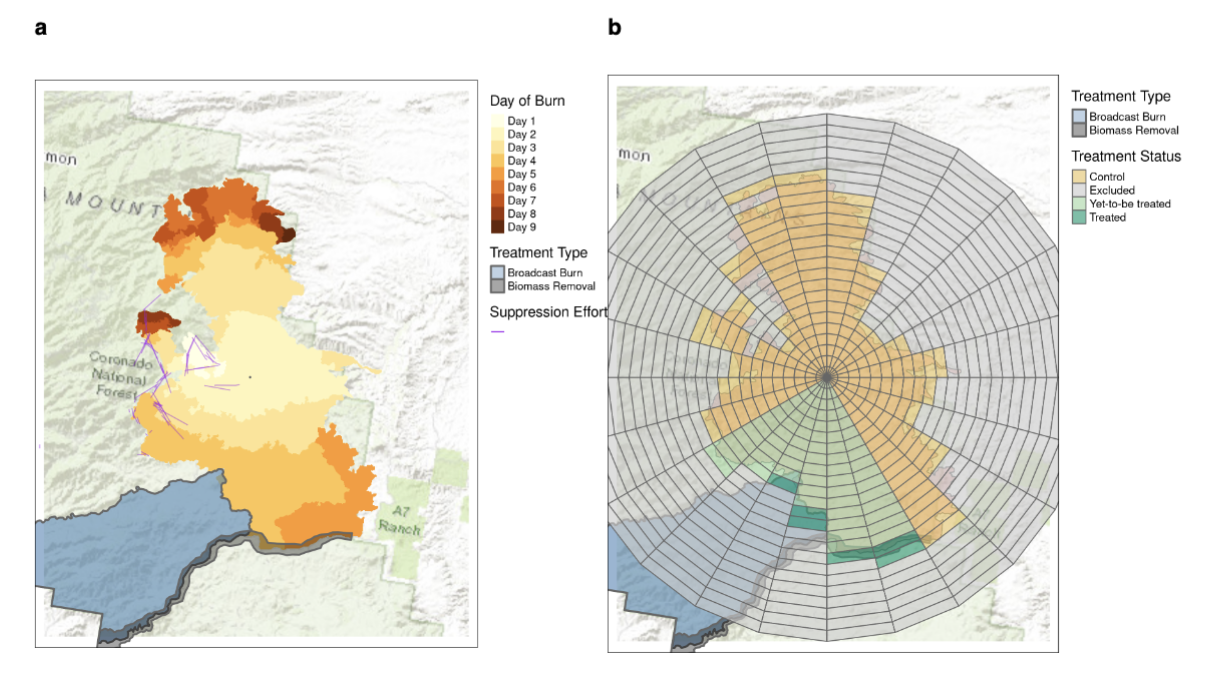
Wildfires are among the most pressing environmental challenges of the 21st century, intensified by the accumulation of forest fuels after a century of fire suppression policies. Although fuel-reduction treatments (“fuel treatments”) are a primary tool for reducing wildfire risk, they remain underutilized, partly owing to limited evidence of their economic value. In this study, we integrated high-resolution data on wildfires, fuel treatments, suppression effort, and damages across the Western United States to assess their cost-effectiveness. Using a quasi-experimental design, we found that fuel treatments reduced wildfire spread and severity, avoiding an estimated $2.8 billion in damages by limiting structure loss, cutting carbon dioxide emissions, and lowering fine particulate matter (PM2.5) exposure. Each dollar invested yielded $3.73 in expected benefits. Our findings demonstrate the value of fuel treatment investments and offer guidance for maximizing their effectiveness.
Abstract
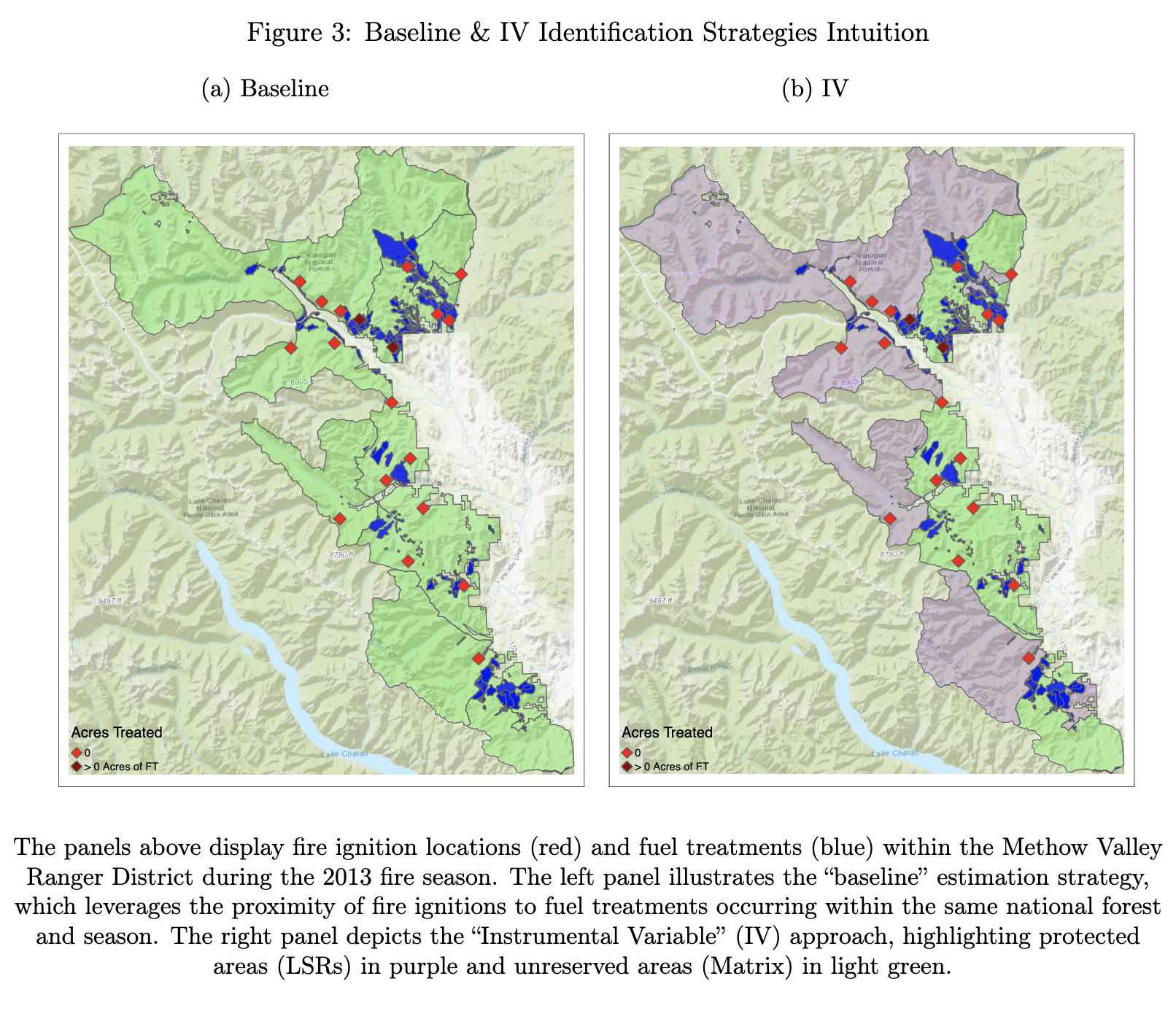
A century of wildfire suppression policies has led to the build-up of combustible fuel loads in forests, increasing the size, severity, and costs of wildfires. This study explores whether fuel-reduction treatments reduce wildfire suppression costs. Focusing on wildfires igniting on U.S. Forest Service lands in the Pacific Northwest, we leverage exogenous variation in protections for the Northern Spotted Owl that unintentionally restrict fuel treatments. Conservative estimates indicate that five to six dollars are saved in suppression costs for every dollar spent on fuel treatments. Our results highlight the potential for reforming environmental protections to achieve economic savings and conservation benefits.
Abstract
Overextraction and excess capacity are longstanding challenges in natural resource industries. Capacity-reduction programs are increasingly common policy responses designed to reduce capacity, reallocate access rights, and improve environmental and economic outcomes. Yet little is known about how such programs distribute benefits and costs among participants who remain in the industry. This paper estimates the benefits accruing from the U.S. Pacific Coast Groundfish Buyback Program, which retired over one-third of its vessel capacity through a voluntary $46 million reverse auction. Exploiting spatial variation in capacity reductions across ports within a difference-in-differences design, we find that active vessels operating in ports with larger relative reductions realized substantial revenue gains, while those elsewhere saw small or negligible gains. Conservative estimates suggest the program generated approximately $23.9 million in additional revenues net of variable costs and program fees over the first seven years, yielding approximately $4.66 in private net benefits per dollar of fees paid during this period. However, returns varied widely depending on the degree of local capacity reduction. These findings demonstrate that while capacity reduction programs can yield significant economic gains for remaining industry participants, their uneven impacts raise important questions about program design and the balance between efficiency and equity.